
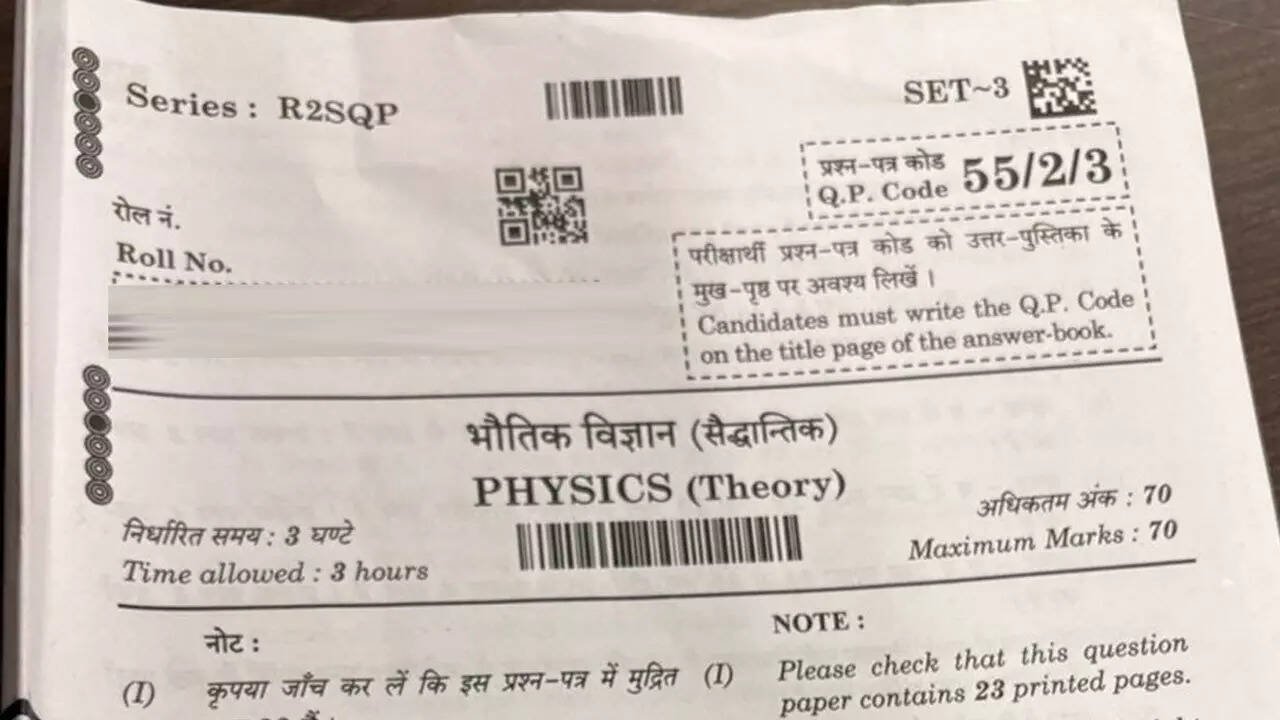
CBSE Physics 2026: Moderate Paper Focuses on Core Concepts
Overview of the Examination
The Central Board of Secondary Education (CBSE) successfully conducted the Class 12 Physics examination as part of the 2026 board cycle. A substantial number of 18,59,551 students appeared for the examination across 7,574 centers nationwide, reflecting the scale and importance of this academic assessment. The examination, which is a crucial component of the CBSE curriculum, concluded with mixed reactions from students and experts alike.
Student Reactions and Initial Feedback
Following the completion of the Physics paper, student reactions varied across different regions and centers. Many students described the paper as moderate in difficulty, while some sections posed significant challenges. The numerical problems and conceptual questions required thorough understanding and application of theoretical knowledge. Students reported that the paper tested their analytical thinking and problem-solving abilities rather than mere rote memorization.
Several students mentioned that the derivations section was particularly challenging, requiring precise step-by-step solutions. Others found the conceptual questions to be well-designed, effectively testing their understanding of fundamental physics principles. The overall consensus among students was that the paper was fair but demanded careful preparation and a strong grasp of the subject matter.
Expert Analysis and Evaluation
Educational experts and subject specialists have analyzed the Physics paper and provided valuable insights. Most experts rated the paper as easy to moderate, aligning well with the prescribed CBSE syllabus. The question design was praised for maintaining academic standards while ensuring accessibility for students who had thoroughly prepared.
Experts highlighted that the paper appropriately balanced different types of questions, including conceptual, numerical, and derivation-based problems. This comprehensive approach effectively assessed students’ understanding across various dimensions of physics. The paper maintained the expected level of difficulty and covered all major topics outlined in the syllabus.
Question Paper Structure and Content
The Physics question paper was structured to evaluate students’ knowledge across multiple sections. Each section contained a mix of question types designed to test different cognitive skills. The conceptual questions focused on fundamental principles and their applications in real-world scenarios.
The numerical problems required students to apply mathematical concepts to solve physics-related calculations, testing both computational skills and theoretical understanding. The derivations section challenged students to demonstrate their knowledge of mathematical proofs and theoretical foundations, requiring clear and methodical presentation of solutions.
Resources and Support Materials
To assist students in evaluating their performance, CBSE will release the official question paper PDF and answer key. These resources will enable students to review their responses, understand the correct solutions, and identify areas for improvement in their preparation for future examinations.
The availability of these official materials ensures transparency and provides students with valuable learning opportunities. By comparing their attempted solutions with the official answer key, students can gain insights into their performance and strengthen their understanding of key concepts.
Conclusion
The CBSE Class 12 Physics examination for 2026 has been successfully conducted with a focus on conceptual understanding, numerical applications, and derivational skills. The paper’s moderate difficulty level and comprehensive coverage of the syllabus have received positive feedback from both students and experts.
As students await their results, the release of the question paper PDF and answer key will provide valuable learning opportunities. The examination serves as an important assessment tool that not only evaluates students’ knowledge but also encourages critical thinking and problem-solving abilities essential for higher education and future career prospects in science and technology.
